25 April, 2007

"civilized" and "senseless" apparently cannot go together

Not too long ago, I came across not only a blog that is worth reading but also a post within that blog that is especially worth internalizing. Just as a teaser, here is one of the key arguments from the post:
So sure, Virginia Tech is a tragedy, no doubt about it . . . I want that kind of thing to stay as far away from me and my family as is possible. But our reaction to it, in the media in particular, demonstrates the inequity of our concerns for human life. Christianity is supposed to be a global concern for the entire human race.
This comment comes on the heels of a note concerning the proliferation of violent acts throughout the world on (nearly) a daily basis. The point (or, problem) noted is that such concern in the media for such things is only propagated when it effects us in this country.[1] From a secular source, this (selfish) one-sided perspective is understandable. From a Christian perspective, however, such a perspective is not excusable.

This morning, right before I started writing this blog, I was sitting my office at home finding what I could on the "new planet" that is possible habitable--though it is several trillion miles away. My wife, while preparing for the day, listens to the news on the TV in our bedroom. My ADD allows me to do things such as research this new planet stuff and listen to the the news at the same time. (It can be a blessing and a curse).

During one of the commercial breaks, there was a gentleman who came on to offer his condolences for the families who lost loved ones in the VT tragedy. That was not so much of a problem for me. What was a problem was a particular statement made right near the end of his little speech. He said (roughly):
It's hard to believe that such senseless acts of violence could happen in such a civilized nation.[2]
The underlying implication of this statement is deeply troubling. The implication is that violent acts are only deemed "senseless" when they occur in "civilized" nations, which produces the secondary implication that such acts are not "senseless" when they occur in "uncivilized" nations. In other words, violent acts emotionally trouble those who are members of an advanced, educated, civilized society. What this does is allow those who say such things to turn their heads from the tragedies that occur (daily) in cultures that are not advanced, educated, and/or civilized.

If we are going to offer condolences to tragedies that effect us in our immediate context, we cannot offer such things in a way that belittles the emotionally devastating effects of violent acts in other contexts--even if they seem to be uncivilized. Human life is human life regardless of where it can be found. When that life is violently taken, it affects everyone who was connected with that life; and it does matter if that life is taken in VT or a tribe in middle Africa. The pain runs just as deep in all cultures.

___________________________________________

[1]
A possible exception to this would be the media's attention on bombings in the Middle East; yet, a case could be made that such announcements are given because they affect our troops, which is to say it affects us in this country. But the question must be asked: how many such acts of violence existed prior to this war; and why were such acts not explicitly noted then? (. . .oh, it's because it only affect them and not us).
[2] I believe this was the exact wording; I tried to write it down the moment I heard it, which ultimately prompted this blog.


22 March, 2007

misplaced priorities (?)

I was bothered by the little blurb about Edwards continuing his campaign in spite of the resurfacing of his wife's cancer. Granted, there are naturally pieces of the story that have probably been left out; but the face value presentation of the article gives the impression of Edwards saying: "Yep, she has cancer; we'll deal with it as we go . . . What's the next stop on our tour?" This is not some kind of some minor bout with bronchitis or a bad case of the runs because of some weird Chinese food; this is cancer! Not only is it bad enough that it's cancer, the article explicitly states that it is "incurable". Edwards . . . hello??!!

The other interesting (yet, bothersome) part about the article is that the decision to remain in the race for Presidency appears to be his and his alone. None of his comments suggests that he cleared this with his wife before deciding to continue on his (current losing) trail;* and none of the comments mentioned from her speak about his campaign. Instead, the implication seems to be her willingness to fight with further implication that she is in this fight alone. Again, there may be another set of comments that are not mentioned in the article; but that's precisely my problem with it. If there are other comments, they should be included so that a really bad light is not shining on Edwards right now. If there are no other comments, then Edwards is the one holding the bad light and shining it upon himself.

The reason this bothers me is because it appears as though he is more focused on achieving a personal goal (if not trying to make a statement--i.e., "I'm better than Bush; elect me and I'll prove it") than caring for his wife--the one he committed his life to when he said, "I do". She is more important than this campaign. She is more vital to his life than making a statement. She is more valuable than any personal goal he could ever attain. But the article--and his decision to remain in the race--seems to flip those comparisons in a really bad way. Edwards, if you read this (though I highly doubt that he will): Step down from the race and care for the most important person in your life--unhindered. There is no problem in doing so. I would highly respect you for doing so. She needs you more than this country needs you--and that's not being rude or impolite.

____________________________________

*According to recent polls, Edwards is a bit behind in the race.

13 March, 2007

current media consumption

This is just a random post--to stay in step with the title of this blog. I took my cues for this from two different sources: 1) my brother's blog inserted this type of material, and I thought it was kinda cool; and 2) I came across something that simply asked: "What are you reading, watching, and listening to right now?" So, here is the answer to that question:

BOOKS:*

Reading for Class
Gordon Fee, New Testament Exegesis
Harold Hoehner, Ephesians: An Exegetical Commentary
Andrew Lincoln, Ephesians
Daniel Wallace, Basics of New Testament Greek Syntax
Reading for Fun
WD Davies, An Invitation to the New Testament
GWF Hegel, Philosophy of History
James Hoffmeier, Israel in Egypt
CS Lewis, A Grief Observed
Andrew Lincoln, Hebrews: A Guide
Martin Marty, Martin Luther
John McRay, Paul: His Life and Teaching
Suetonius, Lives of the Caesars
JRR Tolkien, Lord of the Rings (the complete set)
NT Wright, Paul: Fresh Perspectives
MOVIES:

Recently Watched
The Departed
Hannibal Rising
Sum of All Fears
One Fine Day
Favorites
A Few Good Men
Christmas Vacation
O, Brother, Where Art Thou?
Monty Python: Holy Grail
Princess Bride
Great Escape
MUSIC:

(I'll just list who's in my iTunes playlist)

Live, Sting, 3 Doors Down, Dave Matthews, David Grey, The Times, Coldplay, Susan Tedeschi, Project 86, Third Day, STP, Counting Crows, Jars of Clay, U2, Primus, John Mayer, Evanescence, John Scofield, Kenny Wheeler, San Francisco Jazz Collective, Yo-yo Ma, and a bunch of other classical composers

___________________________________

*In case the question comes up: the answer is "yes", I am reading all of these at the same time. This list does exclude the books and articles that I have to read for my Masters thesis; but that list is way too long to post.

02 March, 2007

scattered thoughts about scattered findings

This post deals with the (not-so-) recent findings about the so-called tomb of Jesus, which is being over-sensationalized by James Cameron. The reason I say "not-so-recent" is simply because this (initial) discovery was done in the 80's--about the same time Geraldo Rivera did his live Capone story, which revealed about the same result as I think Cameron's findings will. There seem to be good reasons for why the initial discovery in the 80's received very little attention and/or media coverage--here are two:
Amos Kloner, the first archaeologist to examine the site, said the idea fails to hold up by archaeological standards but makes for profitable television. "They just want to get money for it," Kloner said.

William Dever, an expert on near eastern archaeology and anthropology, who has worked with Israeli archeologists for five decades, said specialists have known about the ossuaries for years. "The fact that it's been ignored tells you something," said Dever, professor emeritus at the University of Arizona. [1]

In light of the fact that the findings have been known for some time and ignored because of their implausibility, I have noticed a slight trend in how things (re-)emerge in our culture. To oversimplify this trend: something hits the market, it does well for a time, and then fizzles out to near extinction. Then, at some point later--typically when those who were a part of the original trend have passed or who are no longer a loud voice heard within trend-setting conventions--the trend resurfaces under the illusion that it is newer, better, and revolutionary. An oversimplified example of this would be certain fads that are coming into vogue among the teenage population. Today's clothing styles and fashions are nothing more than a (painful) repeat of the 80's with a higher sticker price.

This trend, to me, is obviously not exclusive to general venues such as the clothing industry. Dan Brown's book, The DaVinci Code was not new in the sense that he was the first to investigate the supposed back-story of Jesus and Mary Magdalene and document his findings. His presentation was nothing more than a recapitulation of a legend that had been discounted by serious historians on the grounds that it was anything but historical. But something about the cultural climate allowed his book to become overly popular and considered a real threat to the historical integrity of the Christian message. The same could be said in this case with James Cameron's attempt to discredit the ascension story of Jesus by claiming to have found Jesus' final resting place--which is anything but heavenly.

Before commenting any further, it would be good to remember the astute observations of the New Testament scholar, Luke Timothy Johnson, who shows a consistent pattern within those who claim to have found new evidence about something related to Jesus and/or Christianity.[2] Here is the pattern he notices:
1. It all begins by parading the credentials of the author and his amazing research.
2. Promises are given concerning some new, and maybe even suppressed, interpretation of who Jesus really was and the stories about him.
3. This new interpretation--often considered to be the new "truth" about Jesus--is discovered in sources outside the Bible, which allows the Gospels to be read in a new way which is said to be at odds with the traditional readings/interpretations.
4. This new interpretation is often overly provocative and even controversial to the traditional views. Examples: Jesus married Mary Magdalene and had children together; he was the leader of a hallucinogenic cult; or, he was simply a peasant cynic philosopher.
5. Traditional Christian beliefs are therefore claimed to be undermined and in need of revision.
Johnson goes on to stress that the undercurrent within this pattern is an attempt to bifurcate history and faith--i.e., the two cannot exist. Because such a distinction must exist, and because we are the bastard children of the Enlightenment, what is unseen must cohere with what is seen because what is seen can be proved with certainty. Many, if not all, of the above elements can be found in Cameron's "Lost Tomb of Jesus"--with the possible (though I believe unlikely) exception of #5. His own comments suggest that he is not trying to undermine traditional Christianity, for his findings do not affect the "faith" that emerged from the stories concerning the historical Jesus. Here is a quote from the Discovery Channel website:
If Jesus’ mortal remains have been found, this would contradict the idea of a physical ascension but not the idea of a spiritual ascension. The latter is consistent with Christian theology.
What's interesting is that the idea of only a "spiritual" ascension, which is said to be believed by "some Christians", is not consistent with traditional Christian theology. So to push the idea that the ascension was only spiritual does in deed (attempt to) undermine traditional Christianity. What is also interesting about this claim is that it focuses on the ascension of Jesus instead of the resurrection, which used to be the common target of dispute. To go after the ascension like this would be a significant attack on the fundamental claims of Christianity, which do in fact claim that Jesus actually ascended into heaven after giving the parting instructions to his followers. Cameron and those in tow cannot make the claim that their supposed findings will not cause a few ripples in the pool of Christianity.

But before we get too worried about these supposed findings that may supposedly undermine traditional Christianity, it is best to consider the facts about the findings themselves:
  1. It is interesting that Amos Kloner was not a part of Cameron's team[3]--seeing that Kloner was one of the first to investigate the site in the 80's when it was first discovered. His original 1980 publication is noted by the site, which seems to support the intentions of the production; but, conveniently enough, Kloner's 1996 article, which openly claims that the findings of the tomb are not as positive as many had hoped.
  2. It's also interesting that the inscriptions on the ossuaries are not only as conclusive as Cameron touts, but at least one of them is in Latin rendering of a Hebrew name, which just seems a bit odd. (There may be later theological interests for why this particular name is given in Latin).
  3. The patina evidence is also intriguing to the overall find. (Patina is a chemical residue that forms on stuff that is really old and it can be a tool for determining date and other important data). It is admitted, on the website, that the patina on the James ossuary--the one that received media coverage a few years ago (and turned into a decent book)--matches the patina of the ossuaries found in the find being filmed by Cameron. The website even says that this James ossuary is most likely the missing 10th ossuary from the other nine under investigation. Here's the fun part: the inscription found on the James ossuary has been deemed a forgery; and since the patina matches that found in the supposed burial chamber of Jesus' family, that immediately calls into question the reliability of the other nine ossuaries. (Cameron seems to shoot himself in the foot by making this conenction).
  4. The inscriptions are somewhat problematic.[4] The one with Jesus' name is odd, for he is called "Jesus, son of Joseph". The reason for the oddity is that Jesus is never called "Jesus, son of Joseph" by those who knew him either during his ministry or during the time of the early church. The one with the supposed title "Mara", which is promoted to be a form of the word for "master" is incorrect--"Mara" is shorthand for "Martha". Those who wish it to read "master" have an agenda which seeks to connect the whole deal with the legends (re)popularized by Dan Brown's book.
  5. With respect to the supposed DNA evidence: the DNA found in the ossuaries is not able to determine the gender of the bones' original owner. The bigger issue here is also the lack of comparative DNA. Because there is no historical DNA for the historical Jesus, there is absolutely no way Cameron and his crew will be able to prove with any certainty that the DNA found in the ossuaries does in fact belong to Jesus of Nazareth. If by some chance of last-ditch stupidity, Cameron and his crew compare this DNA with anything found on the Shroud of Turin[5]; their efforts will only confirm that the comparison was a last-ditch attempt. If anything, if such a connection is made between the two, it will only prove that an earlier attempt was made at discrediting the story of Jesus' resurrection and ascension.
And we've come full circle. That's all I've got on this issue. I would highly recommend those who actually read this blog to read the posts by the scholars who are far more able than me to speak on these matters. I will conclude this post with an interesting link to an article that was posted nearly a year ago. It's a bit on the pastoral side in its presentation, but it still worth reading.

_____________________________________

[1] This quotation was originally found here.
[2] The following list is adapted from Johnson's book, The Real Jesus: the Misguided Quest for the Historical Jesus and the Truth of the Traditional Gospels (San Francisco, 1996), 31.
[3] Interestingly enough, however, Kloner is cited to be one of the original few who first studied the tomb
[4] Much of this point (and the next) is taken from Ben Witherington's blog, which I highly recommend.
[5] Personally, I see the Shroud as a joke with respect to historical accuracy and probability. The nature and structure of the Shroud goes against not only the burial practices of the time but also the explicit details found in John 19.40 and especially 20.5-7.

01 March, 2007

weighing in on the issue of global warming

Before this post proceeds, please know that everything stated is said with absolute respect. Nothing of what will be stated is a personal attack nor will it be said with any ounce of ill-will. The reason for this post stems from a comment I made to a close friend's blog concerning Al Gore's movie, An Inconvenient Truth. My friend, Jake, then responded to my comment (found here), which prompted a response from me. Because my response wound up being much longer than I anticipated, I chose to submit it as a post--mainly because I did not want to overwhelm his comment page with a lengthy comment. That being said, here we go.
In all fairness, here is my original comment:
I cannot make any judgments on Gore's politics, simply because I haven't had the time to keep up with them. But I do find a bit of irony (if I could even call it that) in the whole enterprise, which leads me to the question of: how much jet-fuel did Gore burn while promoting his endeavor to be more friendly to the environment? It seems to me that if you want to be a poster child for being more eco-friendly, then you should find other ways to market your ideas instead of using ones that only contribute to the problem.

On a completely different but slightly connected note: I also found it interesting this past weekend that, while watching the History Channel, some scientists were working out scenarios of how to cope with a possible mini Ice Age--much like the one that hit in the 14th century. Here's why it strikes me as interesting: these scientists are running predictions for such an event taking place this century. Yet, other scientists are running predictions for global warming for this century.
Now, I cannot include Jake's response to these two comments simply because it was quite lengthy. :-) So, I refer you to the link noted above in the disclaimer. (I would maybe recommend that you open both posts in two different windows; that way, you can see them side by side).

First and foremost, both of my comments were said mostly in jest; and, as we all know, things said in jest have an element of truth in them. (I was no exception to this rule in that instance). So, my comments were originally more for fun than for anything else.

I will have to disagree with Jake (obviously) about the fallacy within my first point. I was not attacking Gore personally; my arguments were specifically aimed at the inconsistencies in his. (I have made it a point in my life to never attack a person; I only go after the arguments made). :-) To essentially say: the massive influx of fuel consumption and the unchecked emissions of dangerous gases into the atmosphere is one of the leading causes for the problem with global warming; while doing that very thing in order to convey that message is, to me, a glaring inconsistency in the argument being made. That's all I was pointing out with my first statement.

I will say that I was bit surprised by Jake's comment:
This observation may or may not be true, although I would argue that if Gore is successful in getting his message heard, what is gained is probably much more than the fuel he uses.
(The "this" in question is a reference to my first argument).

The reason for my surprise comes from the Machiavellian underpinnings of this statement--i.e., the ends justify the means.* The basic premise of my argument was: if there are other means that generate the same ends, then they should be considered--especially if those "other" means are more conducive for the greater good.** I completely understand the need for personal interaction and the benefits that come from that--especially in a public forum. In light of the message Gore wants to give, however, he could have simply made the sacrifice of having that personal touch and advertise the movie like crazy. Given the nature of our current culture, movies are one of the greatest forms of mass communication. (This is just one of the many different "other" means that he could have used to convey his message).

I should also say that I am not opposed to the arguments concerning global warming, nor am I against the issue itself. I do firmly believe that we, as a (global) human race, are doing things to our environment that are not conducive to the plant's eco-system. I do believe that if we continue on this path, we will certainly have to deal with the consequences of our journey--i.e., we ain't going to like where we end up. Where I hesitate, however, is on whether or not we have all the facts. (If this winds up sounding like an inconsistency, I apologize; I am still sorting through this issue, seeing that I am still a newcomer to it).

With respect to the issue of: our planet is steadily getting warmer and will continue to do so if we do not do something about our attitudes concerning the environment; I am not so sure that the first component necessarily stems from the second. As far as scientific evidence is concerned, we truly only have about 150 years worth of hard temperature data, so our pool of intell in this regard is not that deep. In an earlier post, I noted that several scientists in Britain were toying with the possibility that the earth's temperature is greatly affected by the state/activity of the sun--or, the existence or non-existence of sun spots. The conclusion of their findings was the possibility that the earth's temperature goes through cycles, which are reflective of the sun's solar activity. I will also point out that these same scientist rightly promoted the need to be more eco-friendly simply because not being more eco-friendly can have serious consequences when the earth happens to go through one of its cycles. This, to me, is an example of keeping the two components separate.

My second comment, which Jake addressed, dealt with the apparent contradiction between scientists who say that our planet is being threatened with a possible ice age and the scientists who say that our planet is being threatened with a possible global oven. My point in making that comment was that the way in which it was presented on the History Channel gave the impression of a contradiction. Jake's (valuable) insight about an ice age stemming from global warming is probably the way it should have been stated on the HC. My point was that they did not present it in this way. They presented this potential ice age as something separated from the issue of global warming. In fact, one of the closing scientists on the show basically said: is an ice age coming, or will we suffer from global warming; we cannot be sure with any certainty. That, to me, postures the whole issue as being two separate scenarios--not one caused by the other, which would be more likely.

I wholeheartedly agree with Jake about the definite need to be more conscious about what we are doing to the environment--for the sake of generations after us. And, as Jake so aptly pointed out, as Christians we should be more concerned about the state of our environment simply because God gave us that responsibility. To ignore that responsibility has global consequences--it is not something that only effects those who make such a choice. British scholar, NT Wright, once said that it's interesting that we as Christians do not take better care of this planet, when it is this planet that we will return to at the end of all things.*** The point was made in connection with the parable found in Matthew 25.14-28. God has given each person the responsibility of doing something in the service of him. What that "something" is another issue; what matters is how that person handles the responsibility given to them. We, as Christians, have been given the responsibility of caring for the home on which we live, and that responsibility was given to us by God. Therefore, to ignore the responsibility is (essentially) to ignore God; and that is an option that we cannot justifiably make while calling ourselves "Christian."

_____________________________________

*That is an ethical fallacy; and given the ethical nature of the global warming issue, making this kind of fallacy does more harm than good for the arguments made.
**My philosophical tendencies coming out in an obvious way. :-)
***One should not run the counterargument: "well, when the end of all things happens, God will simply wipe out the whole deal and start over with something greater" or, "God's going to fix everything in the end anyway, so why bother?" The parable noted is a large part of the reason why such arguments cannot and should not be made.

28 February, 2007

Sprint woes -- part 2

Once again, I am bothered by Sprint's campaign for fighting AIDS. I noted in an earlier post* that Sprint's big push was that by purchasing a new phone, a small portion of the money would go to AIDS relief in Africa. What I failed to mention, though it is barely subsidiary, was that it troubled me because the ad was given during the week of Valentine's Day--as if that day made people more apt to give in a "loving" way.**

The new ad, which I encountered a couple of days ago, struck me even deeper than the last because they tried to bolster the ethical justification of buying a phone in order to help dying individuals. The controlling statement for this new commercial is: "The power to do the right thing." The implied logic of this statement is what struck me. The implication is quite obvious (in light of the whole commercial): doing the right thing is the right thing only when the one doing the right thing benefits in some way. According to this logic: helping people in Africa is the right thing to do only if we get something out of it--in this case, a new phone.

Just in case this sounds a bit exaggerated: look at how the whole presentation is given. More than 90% of the commercial is about the features of the phone, how it will benefit our lives, and--quite simply--how cool the phone is because it's a sleek red color. This better than 90% is focused entirely on the consumer and why they should purchase this new phone. As a kind of "Oh, by the way"; the part about Sprint donating $17 to fight AIDS is tacked on at the end of the presentation. My question would be: how would the people in Africa feel if they knew that they were helped only because people in America bought a new phone; and that only a portion of the money was given to them? That's not doing the right thing.

The last time I checked, doing the right thing did not involve wanting to know what rewards could be received from doing the right thing. If doing the right thing is determined by what one gets out of it, then (to me) that's not doing the right thing--that's doing the right thing under false pretenses. "When you give to the poor, do not sound a trumpet before you, as the hypocrites do in the synagogues and in the streets, so that they may be honored by men. . . . When you pray, you are not to be like the hypocrites; for they love to stand and pray in the synagogues and on the street corners, so that they may be seen by men. Truly I say to you, they [both] have their reward in full." (Matthew 6.2, 5--emphasis added).

Until we get rid of the mentality of "What's in it for me?", doing the right thing will never truly be doing the right thing. Doing the right thing is the right thing because it is the right thing to do--no other reason.

______________________________________

*It's two down from this one.
**That may be the case. If it is, that is a different blog for a different time.

22 February, 2007

more laziness spotted

Upon leaving the gym* this morning, I was walking toward my car when I spotted an individual who was driving an SUV that was by far too big for them to be driving. The only reason I spotted them was because they almost hit me and didn't show any concern about whether or not they did. (I just happened to have a front space in the parking lot--I got lucky when I pulled in this morning). I got in, unloaded what was in my hands, put the keys in the ignition, and started the car. It was somewhat chilly this morning, so I decided to sit for a moment and let the car warm up a bit before leaving.

Just then, I noticed some headlights behind me--it was the same SUV who almost hit me. This person had pulled into a spot that was behind me and to my right--only a couple of spots further from the door of the gym. I hate to admit it, but my first thought was: "I bet this person is going to take this spot once I leave." To test my theory, I back out and began to leave the lot--all the while checking to see what this person would do. Sure enough: the moment I was clear of the space, they made their way into the now vacant spot. From the moment I got into my car to the moment when they pulled into the space I vacated; the whole process took about 3 minutes.

I was not ashamed of my second thought: "That person is flat out lazy." Why was I so harsh? They were going to the gym! If this person was not willing to walk a few extra steps because they have a spot that is further away; why even bother going to the gym? If this person was in that much of a hurry that they have to have the closer space; then their desire to be expedient was futile because they wasted "valuable" time waiting on me to leave. During the three minutes it took me to leave the parking lot, they could have parked in the back of the lot and walked in (heaven forbid, they get some exercise) before I left.

A word to the person driving the SUV: if you're going to the gym, it's not going to kill you to walk a little further--in fact, it may do some extra good. :-)

______________________________________

* For those of you who actually read this and are keeping track: a few posts ago, I noted that I canceled my gym membership. The reason I re-joined is twofold: 1) my wife and I are able to take advantage of a deal offered through my school, which means we can work out together--something the two of us wanted to do ever since we got married. And 2) I also enjoy working out with my great friend George. (Yes, I go to the gym twice . . . once in the morning with George [to do weights] and once in the evening when Jenn gets off work [to do the treadmill]).

13 February, 2007

Sprint woes -- part 1

I was recently troubled by a new Sprint commercial where the ("Office Space") host announced an new offer. If we, the consumer, were to buy the new Red Motorazr phone; the proceeds from the purchase would go to help fight AIDS in Africa. (The details of this offer can be found here). The desire to help fight AIDS in a country where the disease is certainly in epidemic proportions is not what bothers me. What bothers me is the way in which the whole spiel is given.

First, Ron Livingston (i.e., the host of the commercial) enters the frame with a rather somber look on his face; and in a similar somber tone, he informs us that Sprint has decided to help fight AIDS in Africa with a percentage of their sales. Then, in an overly excited tone (and a quick switch of the background), Ron tells us that we can get a cool new Red phone when we decide to help Sprint in this fight. Then, the scene returns to its original solemnity and Ron finishes the commercial with a troubling statement: "Just in case the saving lives part wasn't enough."*

So, if I understand this campaign correctly: I have to buy an advanced piece of technology for my own enjoyment (for $59) in order to make sure $17 goes to help people in a technologically depraved country (or, countries) who are suffering from one of the more horrifying diseases. If that's the case, then we as a people are not helping to the full extent of our abilities. Not only that, but we are not truly making a sacrifice in order to make sure another person is not placed in a shallow grave. If it was a true sacrifice, then all $59 (or more--heaven forbid) would go to help fight AIDS.** We don't need a new phone. They need to live. And if, according to Sprint's website, the proceeds from this campaign have helped over 12,000 people in Africa; imagine how many more would have been helped had the whole amount been given.

__________________________________________________

* Or something like that. . .I'm doing this from memory.
** This brings to mind the contrasting mentalities of Cain and Abel; and we all know how that story ended.

22 January, 2007

statistical analyses can be misleading

In another attempt to make matters seem worse than they truly are, USA Today posted a brief article on how "Americans" feel about the political situations currently on the table. I put "Americans" in quotes (again) for one simple reason: the poll presents itself as being representative of all Americans, when in reality it is only a very small percentage of the entire population. (The side note in the left margin of the above mentioned article shows that only 1,005 adults were polled in this survey).

I believe that what the writer(s) of these kinds of articles are banking on is that readers (unlike me) will simply focus on the bold print and ignore the small boring print. If such is this case, then the article appears to be saying something completely different--i.e., two-thirds (an ironic number, oddly enough) of this entire country are not optimistic about how things are going. If that were truly the case, then the 200,778,326* people expressing their dissatisfaction is a significant voice--and one that should be heard with great concern. But, only 1,005 people were polled, and two-thirds of that number is 670.335 (obviously the ".335" can be ignored), which translates into only about 1/450,000 of the total population.** Not nearly as impressive.

The language/rhetoric used in such articles can be misleading if one is not careful. Throughout the article, in conjunction with the notion of "two-thirds", the writer(s) use other terms to further the illusion--e.g., "most", "Americans", "the nation", "public", etc. This is not to suggest that the 1,005 polled are not American or not a part of this nation or not a part of the public; it is only suggesting that these 670 only represent 670 positions of the 301,016,980 people within this country. This is also not suggesting that these 670 positions are insignificant and should therefore be ignored simply because they are few; it is only suggesting that they not be considered definitively representative of the entire country. If the writer(s) of USA Today want to show that two-thirds of this country are dissatisfied with the status of various political issues, then survey the entire population of this country and see what happens.***

Statistical analyses, if not seen in their proper context, can be misleading. It is crucial for us readers of such polls not to overreact and/or believe the (false) reality being presented by such analyses. When an article, such as the one in question, says something like "Two-thirds think country headed down wrong track", we must see what that number actually represents instead of believing that actually two-thirds of this country hold that position. It would easy for us to read such a headline an be sucked into the conclusion: "Wow, if that many people are dissatisfied with the President and his agenda; then he must be doing something wrong"; when in reality, it is only 670 people who are dissatisfied. Therefore, the above conclusion would be a bit hasty to make. So don't make it, and realize why it would be bad to make it.

________________________________

* This figure is based on the population of America being 301,016,980, as of 11:30am on 22-Jan-07--according to the US and World Population Clock. It is understood that this number would be smaller given other key variables (noted below).
** Granted, there are a number of variables to consider--i.e., age, race, gender, social status, geographical location, political ties, etc.
*** Well, obviously survey those who are able to respond to such surveys.

10 January, 2007

I am so glad that sex does not sell*

Recently, while carrying out my normal morning routine, I came across this rather disturbing picture used to promote a rather mundane service. At first, I honestly thought it was another one of those promotions for finding "hot singles" in my area; so I ignored it. But when I took a second look, I saw that it was not soliciting hot singles in my area; it was (as you can see) an add for finding individuals to be "secret shoppers". Is the secret shopper industry in such a dire need that the marketers must resort to using such tactics to recruit new employees? Or is such an approach simply indicative of how marketers seek an audience with people within our society?

Exploitation of women for the sake of marketing a new product is a sad commentary for our society. (Please know that I am not relegating this problem only to the US; it is a global trend). This trend can be found when promoting all kinds of products--e.g., Mach-3 razors, Arby's 5-for-$5, etc. I am not quite sure, in light of this problem, which disturbs me more: that such tactics are "normal" (if not acceptable), or that women allow themselves to be exploited for such purposes. I am sure there is all kinds of rhetorical moves made when soliciting the help of young attractive women that make it seem as though they are being honored and performing a valuable service. But five minutes of reading between the lines would reveal the true rhetoric being presented. What can be found between the lines is anything but honorable and it quite insulting.

Marketers know that sex sells, and such a mentality pervades the vast majority of social life. This raises another question that ultimately disturbs me. What's worse: the fact that sex sells and marketers exploit that to the extreme, or that there is an underlying assumption that presupposes a lack of interest in a product (from the consumer) unless it is presented in a sexual way? In other words: is our society conditioned to desire things only when they are sexually alluring? Whatever happened to something being desirable simply based on the merits of the product itself?

___________________________
* Stated with the most sarcasm I can muster.

09 January, 2007

pills are not (always) the answer

Amidst the barrage of other "get fixed quick" medicines is yet another weight loss pill guaranteed (with pretty much the same guarantee as all the others) to help reduce weight and body fat. The wonderful miracle pill: Lipozene. One brief comment before getting into the heart of this post: it may be clinically proven to do what it does--i.e., reduce weight and body fat (though I personally have my doubts)--but it has yet to be proven what it will do to one's body 10 or 15 years down the road. (Of course, that's pretty much the same nagging question yet to be answered by the makers of all the other "get fixed quick" meds).

Here's my problem with this new (non-)wonder drug: Within the sales pitch, by the seemingly nice lady on the video, is a short blurb about an "amazing" perk with Lipozene. If we take this pill, then we do not have to change our lifestyle--we can continue eating as we have been. As long as the we take Lipozene, we have nothing to fear about eating what we want. Another implication within this is that we do not have to join a gym or (more pointedly) get off the couch and do something. That, to me, is absolutely asinine! The lifestyle is more than likely the leading cause of why some of us added on the pounds in the first place. To say that a lifestyle change is not needed, while certainly an enticing plug, is not going to solve the primary problem.

The primary problem is that we need to acknowledge the cause for the extra poundage--i.e., not eating well, not exercising, being flat out lazy, etc--and change those habits. There are more established findings that general exercise and eating well have significant results on the whole person. And here's the greatest part about making such lifestyle changes: it's cheap!! In fact, for the most part, it's free!! Lipozene cannot guarantee to save us money--mainly because they want our money. When it comes down to the bare bones, they could honestly care less about us losing any weight. Their primary concern is to convince us to buy their product (for nearly the rest of our lives) so that they can make a ton of cash.

And that's just it--if we want to maintain the results, we have to keep buying the product (for $29 a pop). And if the maximum dosage is taken (6 pills per day), one bottle is only going to last 10 days. Now they may try to sucker us in by giving us a free bottle when we buy the first one ("oh wow; gee thanks! . . .), but that is only a one-time deal (. . . jerks"). And if one bottle only lasts 10 days, that means at least 3 bottles per month for 12 months, which obviously translates into 36 bottles per year for $29 each, giving us a grand total of: $1,044 per year. (Keep in mind: if we want to maintain the result they promise, we have to keep buying the pills). My basic one-year membership to Gold's Gym: $469 (beat that Lipozene).* Even if we choose not to pay for a gym membership, there are many websites (including Gold's Gym, for example) that have information on things that can be done around the home--for free!

If we are completely honest with ourselves, we would realize the really bad logic within the rhetoric of commercial advertising. Their whole job is to make their product sound/seem beneficial and worthy of the consumer's hard-earned money. Try this experiment the next time you're watching TV (especially if you watch late-night TV):** listen to the list of perks given or arguments for why you should buy certain products. I guarantee you that they will be nearly parallel to other products that promote the same concept. (This especially applies to info-mercials where each product [most notably exercise machines of some kind] uses a standard list of comments). The industries who use this rhetoric are truly only concerned about getting money. But here's the thing: buying their product is not always going to solve the problem.*** In fact, buying their product may generate other problems (e.g., financial troubles due to buying stupid products); though if you watch TV long enough, there may be another product to help with the new problems--one that is "guaranteed" to help. It's a meaningless and vicious cycle that can be avoided.

__________________________________

* I have recently cancelled my membership--not because it interfered with my lifestyle, but because I realized that I could general stuff around the house (for free) and get nearly the same results.
** Another experiment to do with late-night TV is to notice the kinds of commercials shown at that time in relation to those shown during the day.
*** I openly admit that there are some medication that are needed in order to help alleviate/regulate various struggles (e.g., clinical depression); but this does not necessarily apply across the board--especially weight loss.

22 December, 2006

nothing really needs to be said, but . . .

Nearly each morning, I have a sad routine that I follow once I go online: check e-mail; read all my friends' blogs*; search through Squizzle's new stuff--i.e., pictures, movies, etc; check out Ebaum's stuff; occasionally look at the Slate; and sometimes I'll read through some of the BBC. Like I said, it's a sad routine; but hey: everybody's get one.

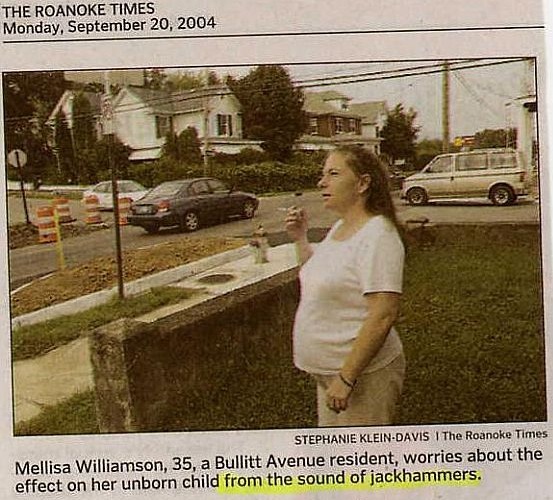
A couple of days ago, while following this routine, I came across this picture on Squizzle. This is truly one of those instances where nothing really needs to be said, but I simply cannot stop myself. (I will try and keep my waxing to a minimum, though I cannot promise I will succeed--the picture is saturated with elements that simply beg for comment).

First of all, I'm not real sure how long ago this article was run in the papers; but that's really not my concern. My primary concern is that it exemplifies certain strands of thought that run through our society--many of which some do not see as problematic. One of these strands is the tendency to find another cause for problems that are ultimately self-induced. The dude in this picture is doing just that. He's not willing to own up to the possibility that his smoking is the cause of his coughing. There was another article that illustrates this same way of thinking--as seen in the following picture:

Another strand, which is only implicit in this, is what some people have called "the entitlement mentality". While this mentality has so many variables connected with it, the primary one is: because someone (or something) else is (supposedly) at fault for another's problem, that someone (or something) owes the one who is "suffering". Part of this thinking may be closely connected with the idea that lawsuits are the new lottery. (Don't know how to handle or drink a hot cup of coffee? That's okay; spill it on yourself and sue the company for a boatload of money because it's obviously their fault).**

People need to own up to their own problems and admit it when they are the cause of them. Casting blame elsewhere and/or suing corporations for large sums of money will not remedy the heart of the problem, nor will such tactics actually improve one's quality of life. It is only when people acknowledge what's wrong in their own life--and recognize that much of it is self-induced--that people can truly make a change for the better.

________________________________

*Jake, Chad, Derek (my brother), and Dr. Weatherly (a professor from my school).

** A local coffee shop here in Cincinnati has one of the best messages on their cup-sleeves that I have ever seen. It simply says: "Don't be a bonehead--this stuff is really hot".

15 December, 2006

history, or historians?

In a recent USA Today article, the headline simply read: "Majority say history won't be kind to Bush". That phrase alone is immediately problematic because it only takes a moment to see what they classify as the "majority". They say 54% of the people polled believe that Bush is not going to receive flying colors in historical recollections about his time as president.

Cast your eyes leftward--that 54% is only 54% of 1009 adults. They try and make the variables sound more fair by saying this 1009 pool is "nationwide" and that it has a 3% margin of error. The ironic (or, convenient) part about the margin of error is that even if the numbers were 3% less, it would still maintain a "majority" status simply because it is greater than 50%. (Statistical analysis is a careful science that can be used to promote just about anything, if one knows how to set up the test and manipulate the variables).

That aside, there is another problematic element to this article. "History" is not some disembodied critic of human affairs; the historians are the ones who are responsible for how history is critically understood. This truth is nothing new--it has been firmly set for several millennia. The ancient Egyptians were known for only recording that which was beneficial to their imperial autobiography. Very few--if any--overly negative events in Egyptian history were recorded. The historians were the ones who determined what they would write; but their refusal to document certain events does not mean that such events did not actually take place. The same is true today.

If history (or, better yet: "historians") is not going to be kind to Bush, then there is only one culprit to blame. Now, this statement does not proceed from my fingers naively--I fully understand that Bush has made some decisions in the past that were not necessarily "good" ones; but it is only by being on this side of retrospect that we can truly know the quality of a past decision. It is very possible that the points at which various decisions were made by Bush and his committee, they were most likely concluded to be "good". It is impossible to know for certain just how dramatically (or, traumatically) a given choice will unfold once it is made. There are simply too many unknowns.

Historians have the choice to include or exclude certain events in their presentation of history. They have the choice to present Bush in a negative light or in a positive one. They have the choice of focusing solely on his faults or on his accomplishments. They also have the choice to take a "both-and" approach in their presentation--i.e., they could be fair and balanced in their portrayal. They cannot, therefore, hide behind some disembodied entity called "history" and place all blame on such an entity while claiming complete innocence. If historians choose to portray Bush as a completely incompetent president whose decisions plunged this country into the abyss, then that's their choice (not really sure it's a good one); and it's a choice where they already know how it will unfold--"history won't be kind to Bush."

30 November, 2006

the "beauty" of photosmart

Last night, Jenn (my wife) and I were watching the evening news--well, she was watching, I was half-way paying attention--when we heard about the following story. Thankfully enough, this quasi-mini-documentary was found under the segment "Don't Waste Your Money." Personally, I think there should be a tag-line that reads: "And Don't Be A Complete Idiot."

Think about this one with me: if you happen to be overweight, and if you happen to be (overly) self-conscious about it, and if you want to change things; then using a camera that has (get this) a "slimming feature" in its menu options is not truly going to bring about the (real) desired changes. But here is the sad part(s): this camera has been made with that very feature (and that very feature is a part of the sales pitch), and people are (presumably) buying this camera and using it for the purpose of making themselves look thin. There are two key problems with this whole deal: 1) a picture that has been altered does not alter reality, and 2) the marketers of this product are implicitly insulting. Not only that, but they stand to line their pockets quite heavily. With respect to the second problem, consider the following:

As of 30-Nov (9:47--EST) the population of the US is: 300,313,684.*
CDC notes the number of US adults who are obese: over 60-million.**
CDC notes the number of US children who are considered overweight: over 9-million.***
The Photosmart R727 camera runs for: $206.99 (after your wonderful "instant rebate")
These figures translate into a rather captivating potential bottom line: $14.5-billion.

How do I get this? One of the first things to learn in marketing is "know your customer", which tends to bleed into the second lesson: "location, location, location." Another variable to consider, when it comes to mass-production of a given product, is its viability--what is the cost-profit ratio (or, more simply: is the product worth the time and effort--or, even more simply: will it make money?) Therefore, possibly those who wrote the proposal to create this camera with a slimming feature possibly did the same quick analysis I just did, which took only about 10 minutes. They got to know their (potential) customers. Having such information handy, the all-important question was dealt with, which produced a rather appealing figure.

Granted, I understand that not all 70-million people who are considered obese/overweight are going to buy this camera--that is not what I am saying. What I am saying is that these are the variables taken into consideration when generating ideas for new products. Even if only a fraction of that 70-million purchase this camera, HP will still receive a nice handfull of pocket change. Keep in mind, the potential $14.5-billion profit is only from one product within the HP line.

Go back to the first problem--i.e., a picture does not change reality. I know it sounds harsh, but it better than honestly believing that a picture will actually change how you feel--or how you actually look. (If you actually believe it will, I recommend reading, "The Picture of Dorian Grey", by Oscar Wilde). I openly admit that I now have a fair amount of insulation around the belly than I have ever had. Many years ago, I was 150lbs and somewhere between 6 and 7% body-fat. Today, I'm around 165lbs and I honestly have no idea what the percentage is. A picture from my honeymoon, which was in August, reveals the reality that I am not what I once was and I confess that I don't like my current state. Now, I could take the logic of the Photosmart sales pitch and use it for my advantage by slimming down the (visually noticable) insulation. But here's the deal: I could do that, put the picture somewhere in my office or some other room in my house; but I would know that the picture does not reflect reality. And if ever I am unsure about whether or not the picture reflects reality, a quick glance in the mirror will give me the proof I need.

Let's not be complete idiots in thinking that a camera is going to solve a particular issue. If problems exist, then we need to use real solutions that produce real results. If we buy into the notion that problems can be masked or altered or concealed, then we have fooled ourselves and we have become blind to reality. Masking, altering, or concealing problems does not make them go away--it only makes them appear more tolerable and/or less ugly. But: altered reality is not real reality.

--------------------------------------------------

* This site has a "real-time" counter--I saw four documented US births and three worlds births in less than a minute. Just for fun, at the time this post was completed (11:00--EST), the US number increased to: 300,314,035.
** This figure, found here, is inclusive of only those between the ages of 20 and older.
*** Same site noted above. The age range in question is between 6 and 19 years old.

03 October, 2006

a (potentially unpopular) different theory

Recent announcements from local and national news have been resounding with similar concerns about the ongoing war and what it means for national security. The primary argument being given is that the war in Iraq is not truly helping; it only seems to be fueling further terroristic plots against America. Therefore, as the logic goes, the longer we stay in Iraq; the more we increase the likelihood of becoming victims of terror attacks in the near future.

There is some truth in this -- partly because of the style of fighting we are engaged in and partly because of the type of combatants we are fighting (i.e., they do not always fight fair). But there may be another reason why Iraqi militants are becoming more courageous in their desires to attack us again. In any type of combat situation -- whether it be war, martial arts, etc -- the key is to watch for weaknesses in the opponent. Sometimes these weaknesses manifest themselves in physical forms (i.e., a bum knee; or, an unprotected border); sometimes they manifest themselves in diplomatic forms (i.e., the one being attacked simply wants to talk); or sometimes, they emerge as a result of psychological struggles (i.e., hope of winning is divided from within).

The first form is always the primary focus; for once a weaknesses is found, exploitation of that weakness is the next step (i.e., continually pummel that area). The second form is the most fun for an enemy to find because it makes his job that much easier (i.e., fish in a barrel). (I should, at this point, apologize for all the "i.e.'s". If they are a bit annoying: sorry). There is a proper place for talking when it comes to dealing with potential conflict -- the key word being "potential". If both parties are willing to seek a compromise before a struggle begins, let'em talk until they pass out from exhaustion. But if one party lurches across the table and sucker-punches the other party in face -- and the assailant has no desire of backing down -- the conversation is over. (I guarantee that if I went up to one of our leaders in government, who simply wanted to talk about things, and punched him in the face; he’s not going to ask me to stop so that we can talk about it. You can bet that he’s going to fight back). The third form of weakness is the one that an enemy truly wants.

My theory on why the terrorists are becoming more anxious: they see the division within the ranks -- both in politics and on the battlefield; they see a nationwide media-promotion advocating surrender and withdrawal; and they even see portions of their enemy’s government (i.e., us) standing behind this promotion. How are they seeing this? Well, we would redefine “foolish” if we thought that these terrorists do not have access to televisions and we would further redefine it if we thought they didn’t watch them. We, for the most part, are basically showing (quite literally) our enemy that we don’t want to fight this war; but remember two things: 1) our enemy does not always fight fair (i.e., they could care less that we don’t want to fight -- they do!), and 2) our enemy has already come across the meeting table and sucker-punched us in the face, and they are certainly not going to stop -- no matter how politely we ask them.

About two years ago, I had the opportunity to speak with a Muslim from Somalia while being transported from my hotel to the Denver airport. The first 10 minutes of the ride was uncomfortably quiet, partly because it was 4:30am and I was the only passenger in the van. The driver then broke the silence by asking a rather pointed question: “What do you think of war in Iraq?” (Not really a topic of discussion I had planned on with a complete stranger -- let alone at 4:30 in the morning). I told him that I was saddened by the fact that the situation had come to war, but in light of the circumstances surrounding it; there was no other choice. To my shock, he agreed with me. Then he said something that has clearly rung in my ears ever since: “Now that you [i.e., Americans] are in this war, you can never leave; and it is a war that will never end. If you do leave, we will go right back to where we were before. If you stay, you have to want to stay because Islamic fighters don’t know how to give up.”

If we are fighting a war with an enemy who does not know how to give up, and if we are fighting an enemy that does not always fight fair, and if we are (inter)nationally broadcasting our lack of desire to fight this war; we are giving them every reason to plot further attacks on our country. I understand that this is not going to be a popular post -- I may even lose one or two of my four or five readers; but I think it is an option that has gone unnoticed for too long.

26 September, 2006

past "million", or past . . . well, a WHOLE lot less than a million

Dateline NBC broadcasted another (laughable) story yesterday on the issue of global warming. Please know that I am, in no way, belittling this particular issue nor am I suggesting that we as a global-community should not be concerned about it. I am, however, suggesting that we keep our perspectives on the ground and in check, which will in turn generate proper and beneficial responses to the problem. (If the issue is presented in an outlandish and overly exaggerated manner, then the solutions offered will be based on that information rather than actual evidence).

The brief story given by Dateline did not help the effort in remaining grounded, simply because it posited a completely unsustainable argument: "Global temperatures are dangerously close to the highest ever estimated to have occurred in the past million years, scientists reported Monday." A more provable -- albeit with great difficulty -- argument was given later in the report by Alan Robock: "It's certainly the warmest it's been in the last couple of thousand years."

My first question is admittedly a bit rash: how in the crap do they know this? The first recorded concept of a distinction between hot and cold is thought to have come from Aristotle when he defines the four essences of the cosmos. His concepts were then furthered by a later philosopher in the mid-2nd century AD, Galen, who is thought to be the one who coined the term "termperature" and applied a numerical value to the distinction between hot and cold. It wasn't until the 16th century AD that the first concept of a thermometer was created by Giambattista della Porta. Advancements were made to della Porta's ideas over the next few centuries -- names such as Galileo, Santorio Santorii, Robert Fludd, Gabriel Fahrenheit, Anders Celsius are found dotting the pages of this area of study.

The obvious conclusion is that it is historically impossible to know the conditions of the earth (accurately) before the 16th century AD. Therefore, Sara Goudarzi (writer for Dateline NBC) and the scientists in question have a rather limited scope of data to work with in constructing their argument. The primary argument of these scientists is that the current wave of temperature is on its way up and will continue to do so unless something is done about it. Yet, one must ask: isn't it virtuely impossible to know with any certainty what the temperature curve looked like on the other side of the 16th century? Thus, the conditions prior to this point could have been parallel to what they are now. This possibility is implicitly noted by one scientist, in the story, who said: "The last time it was that warm was in the middle Pliocene, about 3 million years ago, when sea level was estimated to have been about 25 meters [80 feet] higher than today."

If the waters were 25 meters higher than they are today, that logically suggests that the waters receeded (or fell) at some given point in time. (The chief concern today is that as temperatures rise, the icecaps will melt, which will naturally cause the overall waterline of earth to rise). Two possibilities come to mind: 1) the water level evaporated due to the increase of temperatures over the past 3 million years -- a possibility I don't see as all that persuasive; or 2) the earth goes through cycles of hot and cold, which naturally leads to the rising and falling of sea levels based on the (temporary) "melting" and "(re)freezing" of the icecaps.

Finally, a seemingly unrelated question: do scientists actually talk with one another in order to corroborate findings (or, theories)? The reason I ask is because another group of scientists in Britain have found a cosmologically given glimmer of hope to the problem of global warming. According to this study, the sun will be going through a phase where its solar energy will be less than it has been in the past few decades/centuries. The research conducted in this study sought to examine the possibilities of cycles in the earth's temperature in relation to the solar activity of the sun. There are two things that I like about this study: 1) it seriously considers the more plausible alternatives; and 2) it reinforces the fact that, even if this plausible alternative is true, it does not preclude the human race from in its pursuit for finding ways of being more eco-friendly.

31 July, 2006

what kind of message is being sent?

For the past few weeks, there has a been a promotional plug on the cable network TLC about a new "reality" series: The Messengers. Just by watching the initial trailers on the show, my interest certainly peaked. The original commercials concering the show were quite hopeful -- a group of 10 individuals with a passion for reaching out to the socially lost and bringing a message of hope into their seemingly hopless lives. Beyond this plug, not much else was said about the show.

Then the show begins, and a slightly (though significantly) different nuance is given to the "plot" of this new "reality" documentary.* Here is a direct quote from the TLC site (noted above) detailing the purpose of the show: "This innovative eight-part series kicks off July 23 at 10/9c and has a simple yet lofty goal: to find America's next great inspirational speaker. Showcasing 10 speakers from a variety of perspectives, The Messengers explores their ability to communicate the many complexities of life’s toughest lessons. Along the way, the speakers address issues viewers face in their everyday lives and communities." All of a sudden, the original rhetoric implicit in the initial commercials and the explicitly stated intention of the show collide leaving many with questions of what exactly happened.

In my opinion**, the purpose of the show is not necessarily what they originally claimed (though the proclamation was somewhat implicit). The idea of actually walking a mile in someone else's shoes in order to grasp the hard (and really real) reality of what it's like to walk in those shoes is replaced with the idea of finding out who has the best ability to speak to such people in an effective manner. Another implication should be quite explicit: the show is no longer (necessarily) about those on the plagued fringes of society (though the show does involve them); the show is about how inspirational a given speaker (presumably living in a far greater standard of living than those to whom they are trying to inspire) can be in the face of such circumstances.

Once the group of 10 "messengers" complete their given task of trying to inspire a group of social outcasts, they come back to the comfortable studio filled with hundreds of people who then hear a speech created by each "messenger" based on the experience they had. After the speech is given, a small panel*** of judges critique the speech! Immediately following this period of constructive criticism, a vote is taken as to who will be eliminated from the show. Here's the kicker (again, quoting from the TLC site): "The speaker remaining at the end of the series will be crowned "The Messenger," awarded a publishing deal and given the chance to host his or her own TLC television special."

As if that was not enough, the part that troubled me the most was the very presence of one particular judge who was essentially endorsing the nature and outcome of the show: Bobby Schuller -- the grandson of the teddy-bear-theologian Robert Schuller. (Bobby is also a pastor at Crystal Cathedral in southern California). One would think that Bobby, being a minister, and especially being raised under the teaching of his grandfather, would provide a completely different agenda; one that is more in harmony with the original plug for the show -- i.e., actually sending 10 (twelve would have been a better number) people into the depths of lost society in order to bring a message of freedom and refuge. One would also think, in light of the fact that Bobby is a minister -- representing a (somewhat) well-known church -- that he would emphasize actual compassion over ethos; yet, neither one of these can be found.

The message being sent across the airwaves of cable TV -- being typified within this new series -- is indicative of a deeper problem. The focus is being taken off the message and being placed on the messenger; help is being stymied to those who actually need it so that an contestant can ultimately help himself; hope is given to one of 10 (now 9) individuals that they will become successful while millions have little hope of being rescued from their plight. Such is certainly not the message of Jesus, Paul, or any other NT writer; nor is such a message reflective of the message commissioned to those who take on the name of Christ; therefore, these 10 messengers are not really representative of the kind of messagers as defined with the NT. I dare say this: Bono (along with the One Campaign) is doing a far better job of representing the intention of Christ's commission found in Matthew 25.34-40 than Bobby Schuller's new show.

Let's (finally) consider the off-chance that one of the homeless people, to whom these 10 messengers go, sees an episode of this new show. How would they feel if they found out that the only reason why these 10 individuals came into their "world" was to increase the odds of the contestants becoming a host of their TLC show with a publication deal? What king of message would that be? It would certainly not be the message they need to hear (or, see), and it would certainly not be the message that Christ would endorse -- and Bobby Schuller should know that more than anyone.

*If you cannot tell by now, I have a strong distaste for reality shows.
** And we all know what they say about opinions; and I admit that mine is not going to smell much better.
***Surprising lacking the stereotypical make-up borrowed from American Idol -- like every other reality show of this sort.

30 June, 2006

epitome of laziness

As I am writing this posting, I am sitting in a quiet Ethiopian coffee shop in Tucker, GA where I encountered a prime example of culturally-induced laziness. There are only three people in the cafe right now with an expected arrival of a fourth. This fourth individual was pulling into the parking lot when he decided to call the cafe and order a drink -- from his car!

I would have given him the benefit of the doubt -- he may have been in an extreme rush and needed to get in and out as quickly as possible -- yet, I found there was absolutely no reason to grant such a gesture. Again, there were only three people in the cafe (one of which was the owner), so there was no long line to endure. The drink the guy ordered was an easy one to make, so there was no period of waiting needed. He ultimately paid with cash, so there was no fear of being delayed by the credit card machine.

But the greatest variable in why I could not give the guy a break was that when he finally pulled into the parking space, he took his sweet time coming into the cafe to get his drink. If he was in such a rush -- the presumable reason for why he would call-in his order -- then he would have been a bit more swift in getting his desired drink. Yet, this swiftness was nowhere to be found and/or seen.

21 June, 2006

on a car or in the grass - there is no real difference

Recently, while driving through the glorious, pristine, and captivating avenues of upper Price Hill (Cincinnati); I came across an informational sign/marguee in front of the St. Peter & St. Paul United Church of Christ that brought a smile to my face. The smile was not induced because of the deeply moving message placed upon the sign, nor was it stimulated because of the potentially rewarding events advertised as taking place at the church. No, the smile was created because a twofold conviction was affirmed the very moment I read the sign: 1) church billboards, for the most part, hardly ever offer anything deeper than an espresso spoon;* and 2) church billboards, when attempting to offer something insightful, tend to fail miserably in their pursuit.

(Incidentally, the best bilboard signs that I have seen thus far come from Tire Discounters).

The particular sign that I encountered that day carried an element of self-defeat, for it simply read: "Actions speak louder than bumper stickers". (The self-defeating nature of this sign was the ultimate reason I had to smile). The question must, therefore, be asked: how is that sign any different -- in intent -- than a bumper sticker? If the primary criticism against bumper stickers is that they are nothing more than pithy sayings with no life in them (which I'm assuming is the underlying argument of this church); then the same criticism could be placed at the feet of SPSPUCC, for their sign functions in a highly similar way. Since there is no real difference between the two -- other than the fact that one is on a car and the other is in the grass -- a further question must be asked: is the sign actually accomplishing what it set out to accomplish -- i.e., to be better than a bumper sticker? I hope and assume that their intent was to place life (or, actions) in the message set upon the sign, thus making it better than a bumper sticker; the difficulty, however, is that the message does not convey this intent -- it merely falls victim to its own criticism.

* For those unaware, espresso spoons hold far less than teaspoons

17 June, 2006

gotta love new yorkers

The 106th US Open -- one of the PGA's most telling tournaments -- is being held at the picturesque Winged Foot Golf Club in Mamaroneck, NY (which is about a 20-25 miles north of New York City). As of today the leading score is a painful two over par, which is not reflective of the abilities of the players; instead, the scores are indicative of the grueling nature of the course itself. The commentators of this particular open are quietly wagering bets that the winning score will not fall below par in tomorrow's final round. If Phil Mickelson, however, has a round like he did today; the commentators may have to dish out the cake. We'll see.

The real reason for this particular blog was prompted by the final approach of the third-to-last pairing of today's round -- Phil Mickelson and Graeme McDowell. As the two made their way to the green of the 18th hole, in typical NY fashion, there was explosion of excitement and appreciation -- mostly for NY's adopted spokesgolfer Phil Mickelson -- that was probably heard throughout the entire Club (if not over the yelling of Paul Sr. down in Orange County). Mickelson's approach shot was aggressively beautiful -- landing just a couple paces away from one of the toughest hole locations for the whole tourney. McDowell's approach, however, came up a bit short of the green.

The front of the 18th green is anything but inviting -- especially for players who like to play it safe. (The slope of this frontage might as well be redefined as being a wall). The hole placement for today's round was slightly beyond a crucial "ledge" on this green; a ledge that could easily make or utterly destroy someone's round. The margin of error on this ledge is almost non-existent -- it's do or die. McDowell's ball was at the bottom of the wall, on the initial upslope, with just a short pitch to the hole. For some unknown reason, McDowell was trying to be tenderly aggressive with his shot by attempting a little pitch and run; yet, his shot rolled to the infamous ledge, hesitated, and then proceeded to roll backwards. The ball not only rolled back to in front of McDowell's feet, it actually settled itself back its own divot.

*editorial comment: if it isn't apparent by now, I sometimes take a longer route between two points in order to make one. In the words of Chevy Chase, in Caddyshack: "Sometimes the shortest distance between two points is a straight line . . . in the opposite direction"*

The moment the ball stopped its roll in the divot, a smile emerged on McDowell's face which then prompted a respectful wave of laughter throughout the stands. Then, once the response started to subside, a fan unashamedly shouted: "Hit it harder!", to which McDowell smiled again. Now on his fourth shot (on a par-four hole), McDowell has to regain his composure and essentially hit the exact same shot -- only harder. He takes his stance, makes his swing, and watches his ball fly on the same trajectory to the same location on the green; only this time, it held on the ledge and stayed put. The moment the ball stopped moving, the crowd errupted into an applause that would be expected had McDowell holed the shot from 200-yards out.

This type of response is indicative of a New York audience . . . they are passionately involved with what they're watching and they feel unhindered in manifesting such passion -- especially if you're an underdog (or, have underdog-like tendencies, which was apparently the case for McDowell today). They love the games they watch, and they love the athletes that play them. I can only dream of what the players are feeling when they hear such unhindered passion errupt on their behalf.